
The Sacred Heritage of Bengal: A Temple Journey

This series chronicles the remarkable temple tradition of Bengal — from the terracotta marvels of royal capitals to hidden village shrines that preserve centuries of devotion and artistry.
Part I: Bishnupur — The Terracotta Testament
The dusty lanes of rural West Bengal hold secrets that no textbook could ever fully capture. Long before Google Maps and digital cameras became my companions, my quest to understand the sacred iconography of Bengal led me down forgotten paths, into village courtyards, and through conversations with elderly temple priests who still remembered stories their grandfathers had told them. This journey through the temples of Bishnupur, Kalna, and countless smaller villages became far more than academic research—it became an intimate dialogue with the living heritage of Bengal.

A Personal Pilgrimage: Before the Digital Age
My exploration of the temple iconography of Bengal began in an era when fieldwork meant carrying heavy reference books, rolls of film, and detailed hand-drawn maps. Each temple visit was a discovery expedition—hunting for that perfect angle to capture a terracotta panel, waiting for the right light to reveal intricate sculptural details, and spending hours with local guides who knew family histories spanning generations.
In those days, understanding came through direct encounters: tracing fingers along weathered terracotta surfaces, listening to temple bells at dawn, and absorbing the lived atmosphere of these sacred spaces. The iconographic details I sought were not just artistic elements; they were integral parts of communities where devotion, artistry, and daily life merged seamlessly.
The temple architecture of Bengal stands as one of India's most distinctive regional traditions, born from unique geographical, cultural, and spiritual circumstances that shaped an extraordinary artistic legacy. Unlike other regions blessed with abundant stone, the deltaic landscape of Bengal compelled medieval architects to innovate with local materials — primarily brick and the clay that would become their signature terracotta.
What emerged was revolutionary. The temple architects of Bengal looked to their immediate environment for inspiration, transforming the curved lines of village thatched huts (chala) into sacred architecture that spoke directly to local sensibilities. This was not mere adaptation—it was cultural translation of the highest order.

The Three Ages of Bengal Temple Architecture
My research revealed that the religious architecture of Bengal evolved through three distinct periods:
Early Hindu Period (up to 12th century): Dominated by Pala and Sena dynasties, featuring stone sculptures and early brick experimentation.
Sultanate Period (14th-16th century): Islamic architectural influences merged with local traditions, introducing domes, arches, and geometric patterns.
Hindu Revival Period (16th-19th century): The golden age of terracotta temples, coinciding with the Chaitanya movement and regional Hindu kingdoms.
Bishnupur: Where Terracotta Tells Epic Tales
This temple journey begins where Bengal's sacred architecture reached its zenith: Bishnupur, the terracotta capital that transformed humble clay into eternal divine narratives.
My first encounter with the terracotta temples of Bishnupur was nothing short of revelatory. Walking through the ancient capital of the Malla kings, I found myself face-to-face with an artistic tradition that transformed humble clay into eternal narratives.
Iconographic Treasures: Reading Stories in Clay
The terracotta panels of Bishnupur function as three-dimensional manuscripts, preserving both mythological narratives and contemporary social life. Walking along the walls of the Shyam Rai Temple, I could trace Krishna's entire life story—from his birth in Mathura to his divine play in Vrindavan.
But these panels revealed more than religious devotion. I discovered scenes of contemporary court life, hunting expeditions, musical performances, and even European soldiers—reflecting the cosmopolitan world of 17th-century Bengal. The artisans weren't just illustrating ancient texts; they were documenting their own cultural moment.
The Malla Legacy: Royal Patronage and Artistic Innovation
The Malla rulers of Bishnupur (17th-18th centuries) were not just political leaders, they were cultural visionaries who understood architecture as storytelling medium. King Bir Hambir, who built the iconic Rasmancha in 1600 CE, initiated a tradition that would make Bishnupur synonymous with terracotta artistry.
In the heart of Bankura district, approximately 140 kilometers from Kolkata, lies Bishnupur — a town that bears testimony to one of India's most remarkable architectural experiments. Here, between the 17th and 18th centuries, the Malla dynasty created something unprecedented: temples that functioned as three-dimensional manuscripts, preserving epic narratives in baked earth for posterity.
The transformation of Bishnupur from a modest settlement into Bengal's premier temple town began with a spiritual revolution. When King Bir Hambir (1565-1620 CE) encountered the Vaishnavite guru Srinivas Acharya, the encounter "altered the king's course" and "sparked a cultural revolution in Bishnupur" that would define the region's artistic identity for centuries.
The temples of Bishnupur represent a concentrated burst of creative energy spanning barely two centuries, yet their impact on Bengali cultural identity remains profound. The major temples chronicle the dynasty's evolution.

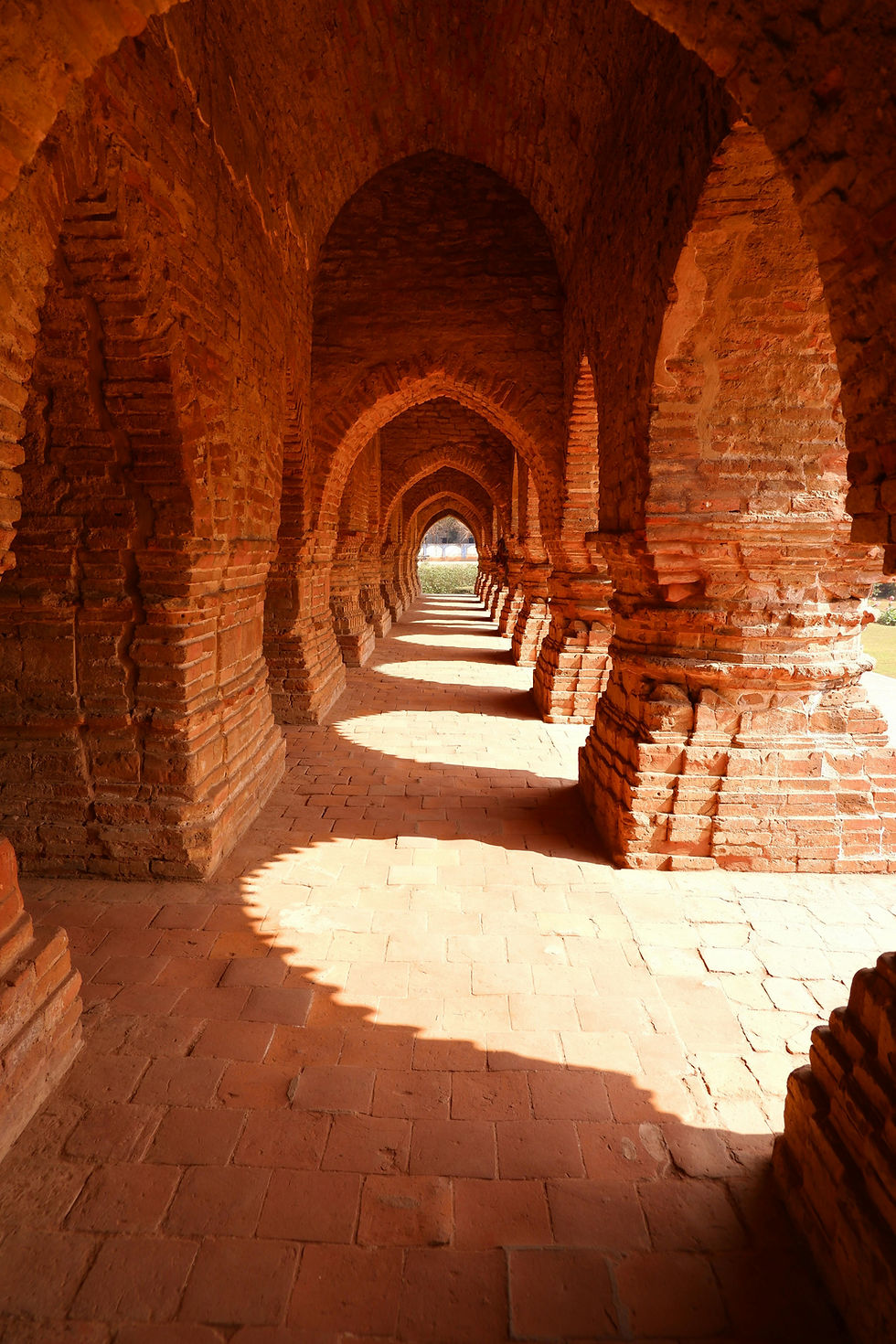
King Bir Hambir's Rasmancha stands as Bengal's architectural manifesto — the moment when local materials and indigenous forms were first elevated to sacred purpose. This "structure, unique of its kind" features a pyramidal design with circumambulatory galleries, representing one of only eight Rasmanchas in al l of India.
My conversations with elderly craftsmen revealed the sophisticated techniques behind the terracotta tradition of Bishnupur. The process began with careful selection of local clay, followed by creation of detailed molds. Each panel was individually crafted, dried, fired, and then fitted into the temple's architectural scheme like pieces of an enormous puzzle.
These were not mass-produced decorations—each panel bore the signature of its creator's individual vision while contributing to unified narrative programs. The artistic guilds, responsible for this work, maintained standards and stylistic consistency across decades of temple construction.
Bengal's temple iconography may be read as a complex visual language that communicated across social and educational boundaries. The terracotta artists developed sophisticated symbolic systems that functioned on multiple levels simultaneously. One of my most significant discoveries was how Bengali artists localized universal Hindu iconography to reflect regional cultural values.
Social Documentation Through Sacred Art
The temple walls I studied functioned as social archives, preserving details of 18th and 19th-century Bengali life that exist nowhere else. I found depictions of:
· Contemporary clothing styles and jewelry fashions
· Musical instruments still used in Bengali classical music
· Hunting scenes featuring local wildlife
· River transport and trading activities
· European colonial presence and cultural interaction
These secular elements were not random decorations; they served to connect divine narratives with everyday experience, making sacred stories immediately relevant to contemporary devotees.
The Craft Revolution: Terracotta as Sacred Medium
The terracotta temples of Bishnupur represent technological innovation as much as artistic achievement. Bengali craftsmen developed sophisticated techniques for creating architectural elements that could withstand Bengal's intense monsoons while maintaining intricate surface details across centuries.
The process involved:
Clay selection: Specific local deposits with optimal plasticity
Panel creation: Individual moulding and firing of narrative scenes
Architectural integration: Fitting fired panels into structural frameworks
Weather resistance: Protective treatments ensuring longevity
This was not primitive folk art but highly developed architectural technology adapted to local environmental conditions and cultural requirements.
Sacred Narratives in Stone: The Epic Tradition
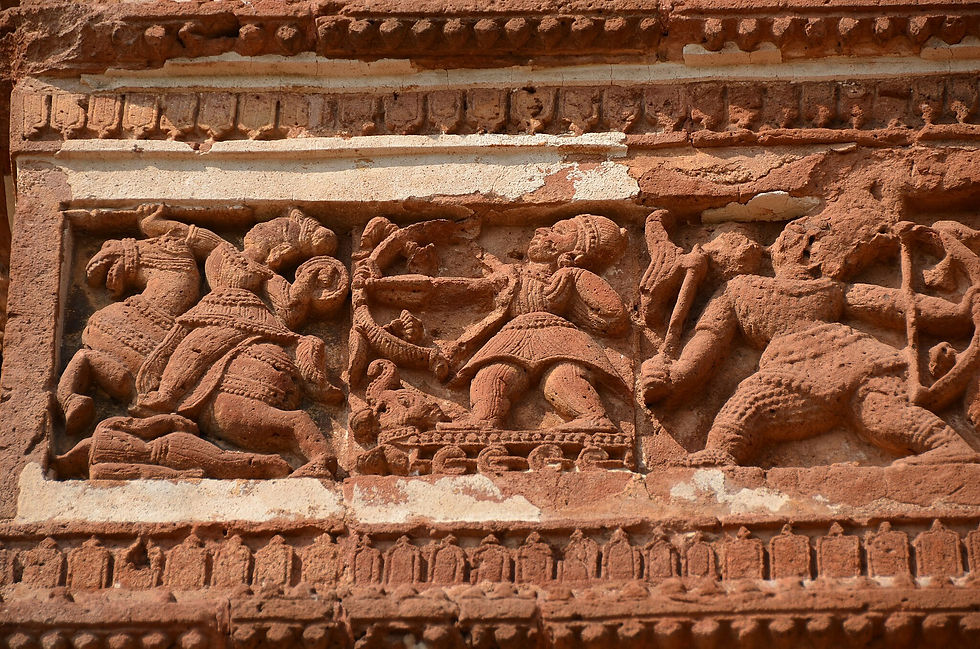
Bishnupur's terracotta panels function as "open books of mythology" that democratized access to sacred knowledge. The temples preserve complete narrative cycles from major Hindu texts:
Ramayana Sequences: Battle scenes, Hanuman's adventures, Sita's trials
Mahabharata Episodes: Kurukshetra war, Draupadi's swayamvara, dharmic debates
Krishna Leela: Divine childhood, cosmic revelations, Ras performances
Contemporary Documentation: Court life, hunting scenes, musical traditions
These panels served dual purposes: artistic beauty and spiritual instruction, making complex theological concepts accessible to devotees regardless of literacy levels.
The cultural significance of the temples of Bishnupur gained formal recognition when they were included on UNESCO's Tentative World Heritage Sites list in 1997. The Archaeological Survey of India designation as "Monuments of National Importance" reflects their status as irreplaceable cultural treasures.


Comments